

Be the first to review this product
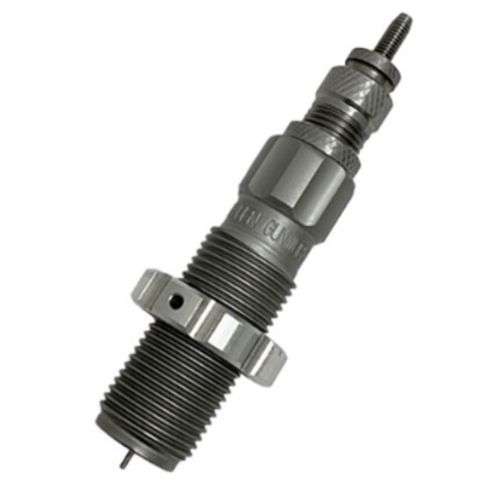
*Whidden Bushing Full Length Dies

%1 In Stock
SKU's
whid-std-bush-f/l***
All dies are supplied without bushings.
Whidden Gunworks reloading dies are the best way to be sure you are getting the most out of your time at the reloading bench. Both the Whidden Bushing Die and Whidden Standard Die are manufactured to tolerances that exceed most expectations.
BUSHING DIE - The Whidden Bushing Sizer allows the flexibility of neck tension should a different thickness in the neck of the brass occur from one manufacturer to another. The bushings also allow the shooter the opportunity to achieve the desired neck tension after neck turning of the brass. The bushings allow for .001” increments in neck tension in a range from .20 to .408 calibers.
FEATURES - Whidden’s Standard Sizer Dies include a shoulder datum collar for measuring shoulder bump and headspace, along with a pin retainer for optional use without the expander. Wide knurling on both the die and lock ring allows easy hand adjustments, while tight tolerances ensure consistent, repeatable measurements. Each die includes a locking ring that secures with an Allen set screw, maintaining the preferred setting between reloads without the need for readjustment.
Write your review
About the *Whidden Bushing Full Length DiesNew Products
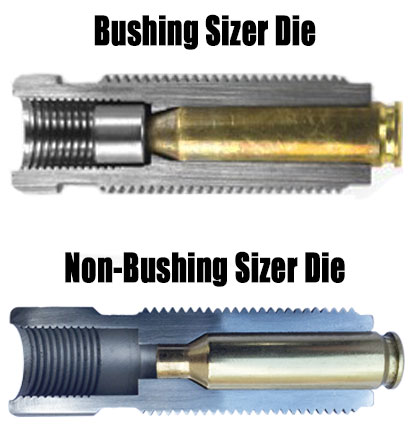
Bushing vs Non-Bushing Sizer Dies
Quite often we hear the question “What is the difference between a bushing full length sizer die and a non-bushing full length sizer die and which is best?”
Full length sizer dies can be broken down into two types. With no preference on either, these types include the bushing sizer die and the non-bushing sizer die.
The bushing sizer die uses a bushing to aid in the sizing of the neck while the body of the die does the sizing of the case body. When sizing the case, the bushing of the die is pressed around the outside of the neck just after the expander ball of the die passes through the neck. As the neck enters the bushing the bushing applies a predetermined amount of tension on the neck. The amount of tension is determined by the size of bushing used. As this action is performed the inconsistencies of the case neck wall are forced to the inside of the neck. As the sizer die is removed from the case the bushing exits the case neck and the expander ball returns through the neck. The diameter of the expander ball will determine the neck tension. When this action occurs the inconsistencies of the case neck wall are forced back to the outside of the neck case. In our experience this allows for a more consistent neck tension when the case is loaded.
Some shooters prefer using no expander ball with a bushing die. In this case the expander ball is replaced with a pin retainer. The pin retainer is used to retain the decapping pin and protects the stem of the die. It serves no function in sizing. When a bushing sizer die is used with no expander ball, neck sizing is done by the bushing itself. With this method the amount of neck tension is determined by the size of the bushing as it is the only and last area of the die to be in contact with the neck of the case.
The non-bushing sizer die works basically like the bushing sizer die. However, the non-bushing sizer die uses an expander ball to size the neck of the case. The expander ball passes through the neck of the case and sets the amount of neck tension. The non-bushing die is designed to size the outside of the neck as the case enters the body of the die. In determining neck tension with the non-bushing sizer die, simply change the expander ball size to obtain the desired amount of tension.
So now, which is best? We’ll let you decide....
The bushing sizer die allows more flexibility in the amount of neck sizing. This is beneficial when changing brands of brass, neck turning brass to achieve different wall thickness and experimenting with different neck tensions in loading. To ease case neck entry into the bushing, all bushings have a small radius on the inside edge. This radius doesn’t allow the sizing of the case neck fully to the shoulder.
The non-bushing sizer die typically yields more concentric ammo in our experience. It also fully sizes the case neck fully to the shoulder for smoother functioning. Neck tension can only be determined by changing expander balls with the non-bushing die.
These two die types are not to be confused as being interchangeable. If a bushing die is used, a bushing must be used to ensure the case is properly aligned in the die. With a non-bushing die, a bushing cannot be used.
We also made a video on this subject that you can check out here.
INSTRUCTIONS CAN BE FOUND HERE
FAQ's FOR THESE DIES CAN BE FOUND HERE
Choosing the right bushing
Question: What Bushing is correct for my Whidden Bushing Die?
Answer: Measure the neck diameter of a loaded round that you've produced with the brass & bullets you plan to use. Subtract .002” from the diameter you measure to select the bushing size.
NOTE: Measuring several loaded rounds and using the average is advisable.
AS AN EXAMPLE: the loaded rounds measure on average .270” at the neck.
.270” - .002” = .268”
For this example, a .268” Bushing would be a good starting point to obtain about .001” neck tension. Obviously to obtain more neck tension a smaller size bushing would be needed.
Question: If the neck of my rifle's chamber is .XXX, May I select the desired bushing for my Whidden Bushing Die from this measurement?
Answer: NO. It is not advised. The bushing size is dependent on case neck thickness and bullet diameter, not the chamber of the rifle.
More Information
| Type of product | Bushing Full Length Sizers |
|---|---|
| Barcode | whid-std-bush-f/l*** |
| SKU's | whid-std-bush-f/l*** |
| Brand | Whidden Gunworks |
Reviews
Ratings & Reviews